

Child support in Los Angeles is not set by parenting time alone: California’s statewide guideline formula weighs both parents’ income and the time each spends with the child. According to the California State Legislature, the amount produced by the Section 4055 formula is presumed correct. A child support attorney in Los Angeles can help you understand how income, custody arrangements, and added expenses may affect the order, and how enforcement or modification works.
It’s understandable to want a clear figure when child support affects your household and your child’s stability. In California, the amount depends on several factors, not one simple rule. Knowing what goes into the calculation can help you understand a proposed order or an existing support amount.
This article explains how California’s guideline calculation works, how income and parenting time affect support, and how courts may address medical, childcare, education, special-needs, or travel expenses. It also covers enforcement and when legal representation may help you understand a dispute and the issues involved.
Key Takeaways
- California’s guideline formula provides the starting point for support, while a child’s age and circumstances can affect how long payments continue.
- Learn which enforcement measures may apply when court-ordered support goes unpaid and what steps can help address a payment issue.
- See how income, earning capacity, and parenting time can shape the support calculation, and why changes in circumstances may matter.
- Understand how medical, childcare, education, special-needs, and visitation-related expenses may be handled alongside guideline support.
- Use the attorney directory section to consider what legal representation can address when support is disputed or connected to broader family-law issues.
How is Child Support Determined?
In Los Angeles County, California, courts use the statewide guideline formula, which considers both parents’ financial circumstances and parenting time. The California State Legislature states that the amount produced by the Section 4055 formula is presumed correct.
California Guideline Support Calculations
California’s statewide child support formula gives courts a consistent starting point for setting support. Under California Family Code § 4055, the calculation produces a guideline amount, and California presumes that amount is correct. The presumption matters: a parent seeking a different amount must address why the guideline result should not apply.
California Family Code § 4057(a) provides that the guideline amount is presumed correct unless good cause supports ordering a different amount. The calculation reflects the state’s approach to support, rather than an informal estimate based on one parent’s expenses. Reviewing the inputs and the resulting calculation helps identify whether the proposed order follows the guideline.
Both parents have an affirmative obligation to support their children according to their ability and circumstances under California Family Code § 4053. The custodial parent’s role does not remove the other parent’s support obligation. A useful first step is to compare the financial and parenting information used for the calculation with the family’s actual circumstances.
Los Angeles County Calculation Factors
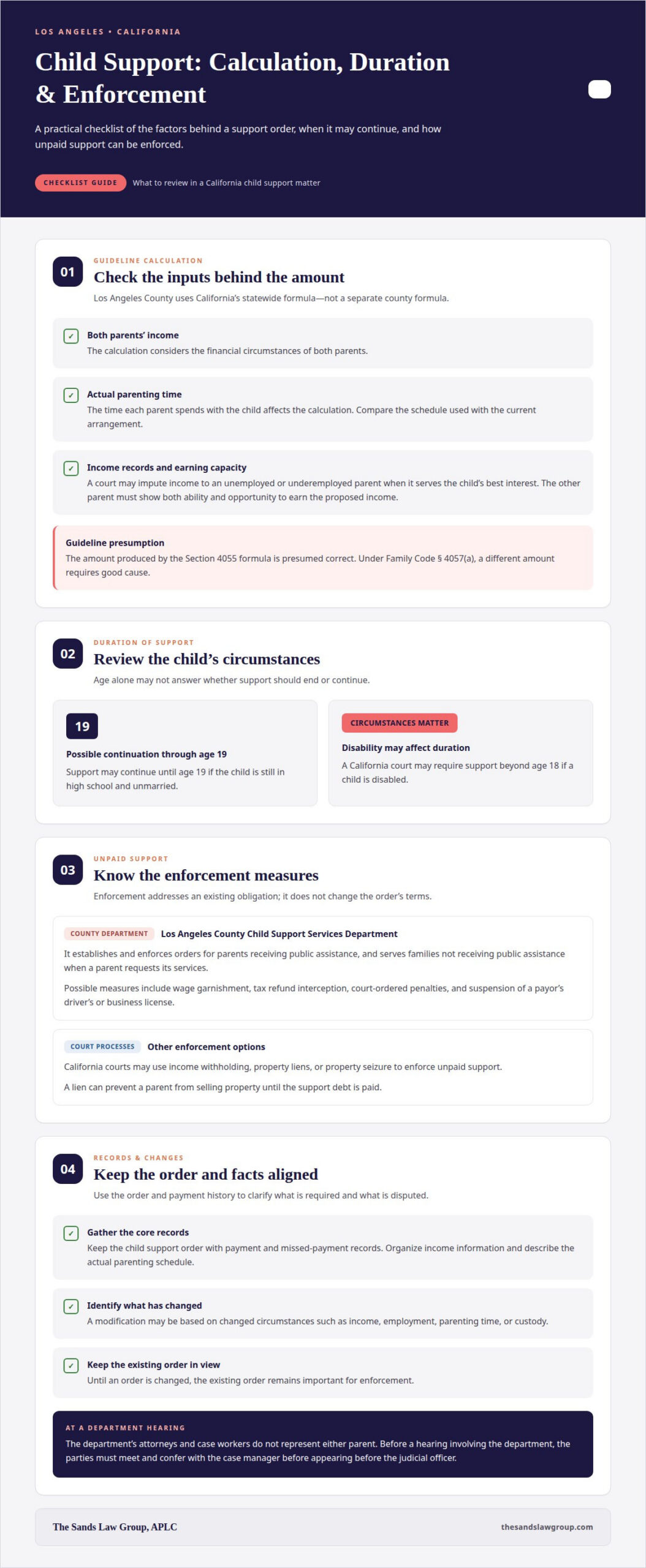
Los Angeles County follows California’s statewide child support formula, not a separate county formula. The calculation considers both parents’ income and the time each parent spends with the child. Because parenting time affects the calculation, distinguish the current schedule from any arrangement that has since changed.
Both parents’ financial circumstances matter. A court may impute income to an unemployed or underemployed parent when doing so serves the child’s best interest. The other parent must show that the parent has both the ability and the opportunity to earn the proposed income.
Accurate information is central to a child support case. When reviewing a proposed calculation, organize income records, describe the actual parenting schedule, and identify any input that seems inconsistent. A family law attorney can explain how California’s guideline applies to your circumstances, while the court determines support under state law.
Duration and Regulations for Support
Parents may have a legal duty to support their children, but how long that duty continues can depend on the circumstances. According to the California Legislature, child support may continue until a child reaches 19 years of age if the child is still in high school and unmarried. The child’s age, school status, and marital status therefore matter when considering how long support may continue.
California courts may also require support beyond age 18 if a child is disabled. This means the usual age threshold does not resolve every case; the child’s circumstances can affect the duration. Parents should review the existing order and the child’s situation before deciding whether support should end or continue.
California Family Code § 4053 frames support around both parents’ obligations and circumstances, while Sections 4055 and 4057(a) govern the guideline calculation and its presumption. When a parent believes the amount or duration no longer reflects the relevant facts, the next step is to identify the order provision and the changed circumstance. A child support order may be modified when circumstances or custody change; until changed, an existing order remains important for enforcement.
Child support enforcement
In Los Angeles County, unpaid support may be enforced through the county department or court processes. A parent seeking to modify an order must address a change in circumstances, such as income, employment, parenting time, or custody.
Options for Unpaid Support
The Los Angeles County Child Support Services Department establishes and enforces orders for parents receiving public assistance. It also serves families not receiving public assistance when a parent requests its services. Enforcement may include wage garnishment, tax refund interception, or court-ordered penalties.
California courts may also use income withholding, property liens, or property seizure to enforce unpaid support. A lien can prevent a parent from selling property until the support debt is paid. These measures enforce an existing obligation; they do not change the order’s terms.
Enforcing Child Support Orders
Enforcement starts with the order and payment history. Keep the child support order with records of payments and missed payments so the amount at issue is clear. In Los Angeles County, the Child Support Services Department may suspend a payor’s driver’s or business license as an enforcement measure.
The department’s attorneys and case workers do not represent either parent. Before a hearing involving the department, the parties must meet and confer with the case manager before appearing before the judicial officer. This is part of the department’s hearing process, not a substitute for understanding your own position.
Whether you live in Beverly Hills or elsewhere in Los Angeles County, the appropriate process depends on the order and your circumstances. Start by identifying what the order requires, whether the issue is a missed payment or a dispute about the amount, and which records are relevant.
Modifying a Support Order
A child support order may be modified when circumstances or custody change. Changes in employment, income, parenting time, or family circumstances may support a request. First identify what has changed since the order and how that change relates to the information used to set support.
Modification and enforcement address different issues. Enforcement seeks compliance with the current order; modification seeks a different order based on changed circumstances. If both are concerns, keep them separate and organize the relevant records for each.
When a support dispute overlaps with divorce or parenting arrangements, representation can help organize the issues and clarify the requested outcome. A parent considering how to address an order can discuss the support-order dispute in the context of the family’s circumstances.
Income and parenting time in support calculations
California’s guideline considers both parents’ income and the time each spends with the child. Accurate information helps show how those factors relate to your family’s circumstances.
How Parental Income Affects Support
The guideline calculation considers both parents’ income, not just the paying parent’s earnings. California child support orders are based on a percentage of the paying parent’s net income or financial resources. Parenting time also matters, so income figures and the actual schedule should be considered together.
If a parent’s work hours or income changed after an order was made, compare current records with the information used for the earlier calculation. Distinguishing a temporary financial difficulty from a sustained change can help clarify whether a proposed amount reflects current circumstances.
Financial Discovery and Income Records
Organize income records before discussing an agreement or disputed calculation. A useful file may include pay statements, tax returns, self-employment income records, and documents showing employment changes. Note the period covered by each record and any gaps or differences that need explanation.
A salaried parent can compare pay statements with tax records, while a self-employed parent can organize business income records. These documents help clarify the income information behind a calculation. Keep a separate record of parenting time, another factor in California’s guideline.
When parents disagree about income, financial discovery may help identify relevant information. Focus requests and responses on records related to earnings, employment, and the period under review. Organized records can make the dispute more specific and reduce reliance on estimates or assumptions.
Imputed Income and Earning Capacity
A court may impute income to an unemployed or underemployed parent when doing so is in the child’s best interest. The other parent must establish both the ability and opportunity to earn the proposed income. A claim about earning capacity therefore requires evidence addressing both, not simply an assertion that more income is possible.
A parent’s decision to reduce work hours does not, by itself, establish the income a court should use. Any proposed earning figure must be connected to evidence of ability and opportunity. Where a financial expert is involved, focus on the relevant facts and supporting records rather than speculation about what a parent might earn.
When income evidence is difficult to interpret, separate confirmed earnings from disputed assumptions. Compare each parent’s records and parenting schedule with the information used in the guideline calculation. This can clarify whether the disagreement concerns actual income, earning capacity, or parenting time.
Education, special-needs, and visitation expenses
A child support order can address some expenses in addition to guideline support. California law treats unreimbursed medical costs and qualifying childcare differently from requests for additional support for education, special needs, or visitation travel.
Medical and Childcare Expenses
Under California Family Code § 4062, courts shall generally order each parent to pay 50% of unreimbursed medical expenses and qualifying childcare costs, unless the parents agree otherwise. The order’s wording matters: review how it describes covered expenses, payment shares, and reimbursement procedures before deciding what is owed.
For an unreimbursed medical expense, keep the receipt and documentation of any insurance reimbursement. For childcare, retain records showing the cost and care provided. These documents help distinguish an eligible expense from a disputed charge and clarify what remains unpaid under the order.
If parents have an agreement about these expenses, compare it with the existing order. An agreement may affect the general 50% allocation, but parents should be clear about which costs it covers and how they will document payment. A lawyer reviewing the situation can help explain how the order and agreement relate.
Education, Special Needs, and Visitation Travel
A California court may order additional child support for educational costs, special needs, or visitation travel expenses when a party requests it. These expenses are not automatically treated the same in every family. A request should identify the expense and explain its connection to the child’s needs or visitation arrangements.
Organize records by expense category. For education, identify the specific cost; for special needs, gather records describing the child’s needs and related expenses. For visitation travel, outline the cost and its connection to the parenting arrangement. Clear records help the court determine what additional support to address.
Consider how a requested expense relates to the child’s interests and the family’s circumstances. Travel costs connected to visitation, for example, arise from maintaining parent-child contact, unlike ordinary household spending. A request should make that connection clear without assuming every expense is automatically payable.
College Costs and Existing Agreements
California law does not require parents to pay for college unless they agreed to do so in a divorce settlement. Review the settlement language before assuming either parent must contribute. The agreement may describe the obligation, covered costs, or how expenses are shared.
Keep the distinction clear: college costs depend on an agreement, while the rules for unreimbursed medical and qualifying childcare expenses are addressed under California Family Code § 4062. If the settlement’s wording is difficult to interpret, a family-law review can help determine what the parents agreed to and how that term applies to the present situation.
Los Angeles child support attorney directory
Choose between county child support services and private representation based on the help you need. The Los Angeles County Child Support Services Department’s attorneys and case workers do not represent either parent. Eligibility for free or low-cost legal assistance depends on the services available.
There’s no single timeline for a child support case in Los Angeles County. The time depends on issues such as agreement, disputed information, and the steps needed before a hearing. Los Angeles child support hearings typically allow about 30 minutes to present evidence, but that is hearing time, not a total case timeline.
County Services or Private Representation?
The Los Angeles County Child Support Services Department establishes and enforces orders for parents receiving public assistance. It also serves families not receiving public assistance when a parent requests its services. The department may help establish or enforce an order, but its staff do not act as either parent’s lawyer.
Private representation is an option when you need an advocate for your position. A dispute about the support amount, custody-related facts, or income information may involve presenting evidence and legal arguments on your behalf. A child support attorney can address your circumstances and the issues you want to resolve.
Eligibility for free or low-cost legal help in Los Angeles depends on the assistance available. Keep that separate from county services: the department may handle a case, but its attorneys and case workers do not represent either parent. Consider whether your concern is establishing an order, enforcing it, or obtaining individual legal representation.
What to Consider When Choosing Counsel
A useful attorney search focuses on the issue involved, such as establishing support, enforcing an order, or seeking a modification. Prepare a concise summary of the disputed amount, the current order, and any changes in income or parenting arrangements.
Ask how the attorney approaches evidence and explains the process. If income is disputed, clarify which records may be relevant; if parenting time is contested, explain the schedule at issue. These practical questions help you understand whether the attorney’s role aligns with your family law concern.
Extremely difficult disputes can involve several connected issues, but the immediate task is to define the support question clearly. Gather the order, payment history, and documents relevant to the disagreement. If you need individual guidance on a Los Angeles support matter, schedule a discussion about your case.
The Sands Law Group, APLC: Divorce Legal Representation
The Sands Law Group, APLC provides divorce legal representation when support questions arise alongside broader family law matters. Child support may intersect with custody arrangements, visitation schedules, and other divorce issues. The firm represents clients in contested and uncontested divorce proceedings.
When parenting time is disputed, The Sands Law Group provides child custody and visitation representation. The firm also handles spousal support and property division as part of the broader divorce process. The relevant issues depend on your circumstances and the decisions before your family.
If you’re considering representation for a divorce or related custody matter, contact The Sands Law Group, APLC or visit thesandslawgroup.com.
Take the Next Step Toward a Stable Plan
Child support decisions can shape daily stability for both a child and each parent. If you’re still weighing what to do, focus first on the decision that needs attention now, whether that involves a disputed order, changing circumstances, or support concerns connected to a divorce. A child support attorney in Los Angeles can help you understand the legal issues involved and consider a practical course of action.
The Sands Law Group, APLC provides Divorce Legal Representation, Child Custody and Visitation Representation, and Spousal Support Representation. These services may be relevant when support questions form part of broader decisions about parenting arrangements or divorce. The next step is to explain your concern and the issues you want addressed.
You don’t need to resolve every related issue before discussing your situation. A focused conversation can help organize the decisions ahead and clarify how legal representation may fit.
Arrange a conversation about your family-law concerns and take your next step with greater clarity.
Frequently Asked Questions
What is Earning Capacity?
Earning capacity means the income a parent may be able to earn, rather than only current earnings. In California, a court may impute income to an unemployed or underemployed parent if doing so serves the child’s best interest. The other parent must establish both ability and opportunity to earn the proposed amount. A past job alone does not establish present earning capacity.
What factors affect child support payments in California?
California child support calculations consider both parents’ income and parenting time. Additional expenses may include qualifying childcare, unreimbursed medical costs, education, special needs, and visitation travel. A court may order additional support for education, special needs, or travel expenses when requested. When reviewing an order, distinguish the guideline amount from expense provisions and note relevant changes in income, custody, or expenses.
How do I find a qualified child support attorney in Los Angeles?
Look for a family law attorney whose work matches your concern, such as a disputed amount, unpaid support, or a custody-related issue. Ask how the attorney approaches evidence, communication, and hearings, and explain your circumstances using the current order and payment history. A Los Angeles child support attorney should explain their role and the issues involved without promising a particular result.
How can I enforce unpaid child support in California?
You can pursue enforcement of an existing California order through county child support services or court processes. Options include income withholding, tax refund interception, property liens, property seizure, and court-ordered penalties. Gather the order and payment history to identify unpaid amounts. Enforcement addresses the current order; modification is a separate issue if circumstances have changed.
What documents should I bring to a child support attorney consultation?
Bring the current support order, payment records, and financial documents showing income changes. Include a written parenting schedule and receipts or statements for expenses in dispute. If enforcement or modification is involved, add relevant notices or court filings and note dates of missed payments or changed circumstances. Organizing documents by issue helps focus the discussion on unresolved questions and timing.
What happens if a parent does not pay court-ordered child support in California?
Unpaid support may be enforced through income withholding, tax refund interception, property liens, property seizure, license suspension, or court-ordered penalties. A child support lien can prevent a property sale until the support debt is paid. These tools enforce unpaid obligations; they do not automatically change the order. This page is for general informational purposes only and does not constitute legal advice. Contacting The Sands Law Group does not create an attorney-client relationship until a formal agreement is signed.

Article by
Thomas D. Sands, Esq.
Thomas D. Sands is the founder and CEO of The Sands Law Group, APLC. A California attorney with more than two decades of experience, he represents clients in divorce and family law matters as well as civil litigation and real property disputes. His approach emphasizes attentive, practical, and cost-conscious representation.
Sands is a 2023 Litigator of the Year honoree of the American Institute of Trial Lawyers and a 2023 Lawyer of the Year honoree of the American Institute of Legal Professionals. His firm has also received recognition among the 2025 Best Law Firms in America, a 2026 Benchmark Best of award, and a 2026 Law Firm of the Year honor.









Leave A Comment