
The court filing fee is only one part of the cost of divorce in Riverside CA: Riverside County charges $435 per spouse to file a petition or response, as of March 2026. Attorney expenses depend on whether the divorce is contested and how complicated the property division becomes, so a single figure won’t fit every case.
It’s understandable to want a clear budget before taking the next step, especially when legal costs add to an already difficult transition. This guide explains how attorney fees and court expenses can arise, why disputes over assets may add work, and how a fee waiver may help eligible people with court fees.
You’ll also learn how the type of divorce can shape the overall expense and what financial issues may require additional work. With a clearer view of the costs and the factors behind them, you can consider your options with greater confidence.
Key Takeaways
- Separate court filing costs from attorney fees and other case expenses to build a more realistic budget.
- Expect the level of disagreement, court involvement, and work needed to resolve issues to influence legal expenses.
- Understand how California’s community property rules may shape asset division and when valuations or other professional work may add costs.
- Review the income and public-assistance criteria that may make a court fee waiver available.
- Consider how an uncontested resolution differs financially from a divorce involving disputed custody, property, or support issues.
How much does a divorce lawyer cost in Riverside?
Attorney fees are separate from court charges, and the legal work required shapes the bill. To assess the overall expense, distinguish court filing fees from attorney representation, mediation, and other services.
Divorce Filing Fees
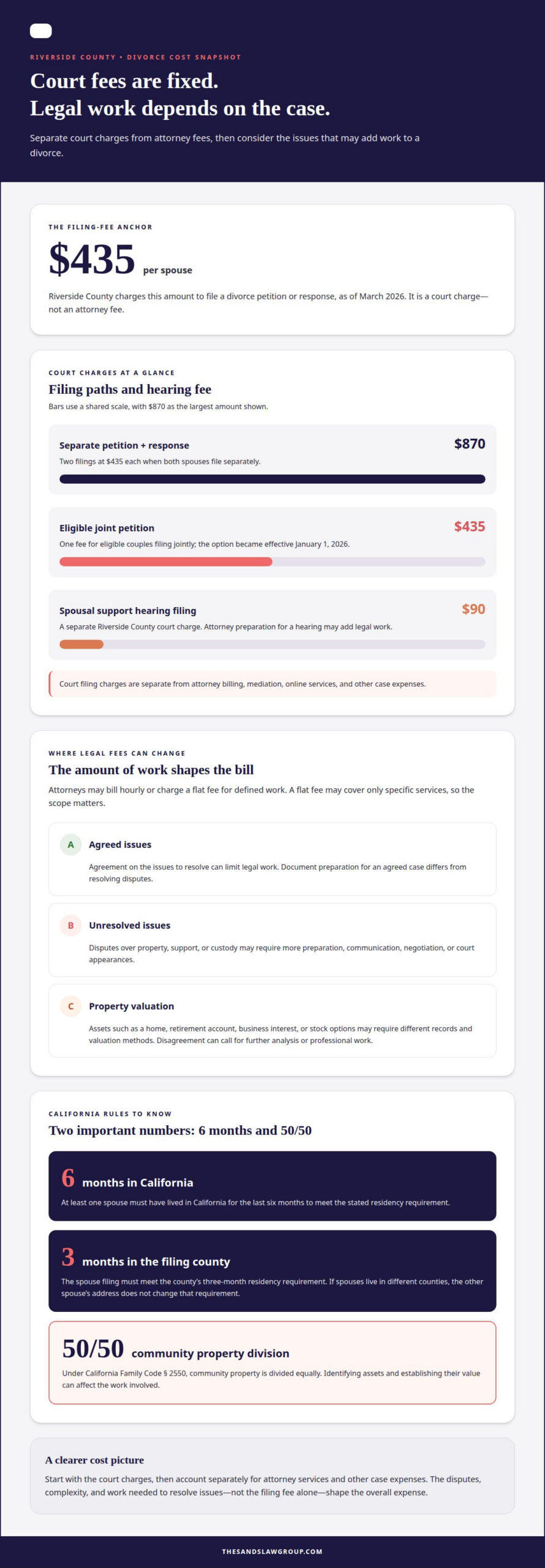
A filing fee is a court charge paid to open or respond to a divorce case. In Riverside County, filing a petition costs $435 per spouse as of March 2026, and filing a response costs the same. If both spouses file separately, their combined filing fees total $870. These charges are distinct from legal fees and other case expenses.
Residency and County Filing
California residency rules determine when a spouse can file for divorce in a county. At least one spouse must have lived in California for the last six months and in the filing county for the last three months. If spouses live in different counties, the spouse filing must meet the county’s three-month residency requirement. The other spouse’s address doesn’t change that requirement.
Meeting the residency requirements helps identify where the case may be filed; it doesn’t determine attorney fees. The Superior Court filing fee is separate from legal fees, which reflect the representation and work involved. Court fees apply to filing documents, while disputes may require more legal work than an agreed case, affecting the overall expense.
California also provides a joint filing option for eligible couples. Effective January 1, 2026, eligible couples can file a joint divorce petition for one $435 fee. This differs from separate petition and response filings, which together cost $870 in Riverside County. The joint option applies only to couples who meet its eligibility requirements.
The cost of legal representation depends on the billing arrangement and the issues that need attention. Attorneys may bill hourly or charge a flat fee for defined work. Disputes over property, support, or custody can require additional preparation, communication, negotiation, or court appearances. The amount of work affects legal fees, so the court filing charge alone doesn’t show the potential total expense.
Mediation and online divorce services have different cost structures. Online service pricing depends on the forms and support provided, and is separate from attorney representation and court filing fees.
For a useful budget, separate the court fee from legal services and any mediation or online-service charges. Then consider which issues need resolution and what support they require. This distinction helps Riverside County spouses understand why two cases can have different total expenses even when the filing fee is the same.
Attorney fees and additional court costs
Attorney fees depend on the billing arrangement and the work required to resolve each issue. Court and case-related charges are separate, so distinguishing them helps explain the overall cost of divorce in Riverside, CA.
Uncontested Divorce Attorney Fees
An uncontested divorce means the parties agree on the issues that need resolution, which can limit the legal work required. The scope matters: preparing documents for an agreed case differs from resolving disagreements over support or other terms.
Some California attorneys bill hourly, while others charge a flat fee for defined work. A flat fee may cover only specific services, so the scope of representation matters when comparing arrangements. Additional requests or disputes can require work beyond the original scope. Clarifying which tasks are included helps you understand how the billing arrangement may affect the cost of divorce in Riverside, CA.
Contested and Riverside Lawyer Fees
A contested divorce involves unresolved issues that require negotiation or court attention, increasing the legal work involved. The number and complexity of disputed issues, including spousal support, affect the preparation and advocacy required.
Riverside divorce lawyer fees may be hourly or based on defined work, and costs can vary across California metro areas. Regional figures provide context, not a quote for a particular case or lawyer.
Additional expenses can arise alongside legal fees. A spousal support hearing filing fee in Riverside County is $90. Those charges are separate from attorney billing, and a case involving a hearing may require additional legal preparation beyond the filing charge itself.
For example, parties who agree on property and support may need less negotiation than spouses disputing income or support terms. In a contested case, each unresolved issue can require document review, communication, and court preparation. The billing method also affects how those tasks appear on an invoice, so distinguish attorney work from court and third-party charges.
To understand potential legal expenses, identify the disputed issues and clarify the scope of representation and billing arrangement. If spousal support is contested, the hearing process and related preparation may affect the work involved. A discussion about divorce representation options can help you understand how legal support relates to the issues in your case.
How is property divided in a Riverside divorce?
California community property rules shape how spouses divide assets in a Riverside divorce. Under Family Code § 2550, community property is divided equally, or 50/50. Identifying what belongs in the community and establishing its value can affect both the proposed division and the work needed to reach an agreement.
Property division starts with a clear picture of the assets connected to the marriage. A home, retirement account, business interest, or stock options may require different records and valuation methods. Ownership documents and financial statements help clarify an asset’s value and whether the spouses agree on it. Disagreement may call for further analysis and additional professional work.
Debts also shape the financial picture. List each balance and account, and note which spouse or spouses are associated with it. Then address disagreements during property negotiations. A home loan and a credit account, for example, raise different practical questions. A proposed division should account for liabilities as well as assets, rather than focusing only on property with positive value.
Agreement can reduce the need for extended disputes about individual assets. Riverside County parties may use mediation to work through disagreements and develop proposed terms. A written agreement can identify each asset, its agreed value, and how the parties propose to divide it. If spouses cannot agree, valuation evidence may help clarify the remaining dispute.
Some property requires an appraisal or expert analysis. This may add expense when spouses disagree about a home’s value.
These expenses can also arise when records are complex or the parties disagree about business finances.
Before filing for divorce, spouses can organize asset and debt records to identify the questions needing resolution. A filing fee covers filing, while a fee waiver addresses court fees for eligible people; neither determines an asset’s value. Child custody and property division are distinct issues, even when both affect the family’s transition after marriage.
For example, spouses who agree on a home’s value may avoid a valuation dispute, while disagreement over a business can require expert work. Identify the disputed assets, the available records, and whether an appraisal or financial analysis could help address the disagreement. These steps clarify where property division expenses may arise.
Fee waivers
A California court fee waiver can reduce eligible court filing costs for someone who cannot afford them. In Riverside County, eligibility may depend on income, public assistance, or financial need. A waiver can ease one part of the cost of divorce in Riverside, CA, but it doesn’t resolve property, support, or other case issues.
You may qualify for a Riverside County divorce fee waiver if your income is at or below 125% of the federal poverty line, or if you receive Medi-Cal, CalWORKs, or SSI. A person may also qualify in a family law case based on low income, government assistance, or financial need. These eligibility pathways concern financial circumstances, not whether the divorce is contested or uncontested.
To request a waiver, complete fee waiver form FW-001 and submit it to the court with the divorce paperwork. The Judicial Branch of California says you may file the request with your petition, with your response, or later if your finances change. This allows a person whose circumstances shift during the case to request a waiver at that point.
The timing can suit different filing situations. A petitioner may submit the request with the petition, while a responding spouse may submit it with a response. If financial circumstances change after the case begins, the Judicial Branch of California allows a later request. The application should accurately describe the person’s financial situation and include the documents required.
A fee waiver concerns court fees, not attorney fees or every expense connected with a divorce. Service of process is a separate budget item from court filing fees, so account for it when assessing the cost of divorce in Riverside, CA.
Fee waivers can apply to an uncontested divorce as well as a disputed dissolution. An agreement between spouses may simplify the issues they need to resolve, but it doesn’t determine whether either person qualifies. Eligibility depends on financial criteria, such as income or public assistance, not agreement about the divorce terms.
Assets and income form part of the financial picture described in a fee waiver request. The court reviews whether the applicant meets the waiver criteria; the request does not decide how spouses divide property. Focus the application on the applicant’s circumstances and provide complete supporting documents. A fee waiver does not replace required case paperwork or resolve the divorce itself.
For a Riverside County spouse who qualifies, requesting a waiver can address court filing costs when filing a petition or response. If finances change after the case begins, a later request may be available. Separating filing charges, service expenses, and legal fees clarifies which costs relate to the court and which arise from other parts of the process.
Uncontested and contested divorce costs
Whether spouses agree or dispute important terms affects the work and time a divorce may require. Children, custody, and unresolved financial issues can add complexity.
Case Complexity and Contested Costs
A contested divorce involves unresolved issues requiring negotiation or court decisions, and each dispute can add legal work.
Having children does not automatically make a divorce contested. Costs may rise when parents disagree about custody, visitation, or child support, because those issues need resolution alongside the petition. If spouses agree on parenting arrangements and financial terms, fewer matters may be disputed. The main cost drivers are the number of disagreements and the steps needed to resolve them.
Costs and Timelines for Contested Divorces
Contested cases can take longer because disputes require negotiation, preparation, and possibly a trial. The timeline for a contested divorce can vary depending on the disputes and work involved. The added time can mean more attorney work, particularly when parties continue to disagree over custody, support, or property.
Uncontested cases generally avoid extended dispute resolution, but total expenses still depend on the paperwork and support needed. This does not account for contested custody or significant property disputes, which can require additional services and legal work.
Mediation can provide a structured way to address parenting and financial terms, but it does not eliminate the need to reach agreement. If discussions fail and the case proceeds to trial, costs can rise substantially.
This figure describes a high-conflict example, not every contested case. The issues matter: a disagreement over one parenting schedule differs from disputes involving custody, support, property, and financial evidence at once.
To understand which path may fit, consider what remains unresolved: the petition, parenting arrangements, child support, or division of property. A divorce lawyer can help assess the legal issues and the work they may require. Discuss your divorce and custody concerns to consider how those issues may shape the case.
The Sands Law Group, APLC: Divorce Legal Representation
The Sands Law Group, APLC represents people in contested and uncontested divorce proceedings. When questions about property division, spousal support, or parenting arrangements complicate the next steps, the firm can provide legal guidance on the issues and decisions involved.
The firm also represents clients in child custody and visitation, spousal support, and property division matters. Legal work may include assessing disputed terms, preparing for negotiations, and presenting your position through the divorce process. The issues in your case determine what guidance is relevant; each family faces its own decisions.
If you’re weighing your options or need help addressing unresolved divorce issues, contact The Sands Law Group, APLC to discuss your circumstances.
Choose a Clear Next Step
Planning for divorce involves more than estimating expenses. It is also an opportunity to identify the decisions that matter most to your future, including parenting arrangements, support, and property. Understanding the cost of divorce in Riverside, CA can help you plan, but applying that information to your circumstances requires careful attention to the issues involved.
The Sands Law Group, APLC provides divorce representation, including child custody and visitation, spousal support, and property division representation. If you’re weighing a contested issue or need guidance on the choices ahead, request a free case evaluation to discuss how legal representation may address your priorities.
Contact The Sands Law Group, APLC to discuss your divorce concerns and consider a practical next step. You can move forward thoughtfully, with your family’s needs and long-term stability in view.
Frequently Asked Questions
What are the residency requirements to file in Riverside County?
At least one spouse must have lived in California for the last six months and in the county where the petition is filed for the last three months. If spouses live in different counties, the filing spouse’s residence determines whether that county’s requirement is met. For example, a spouse living in Riverside County must satisfy the county residency period before filing there.
What is the process of filing like in Riverside County?
A divorce case generally starts with filing paperwork and notifying the other spouse. The responding spouse has 30 days to respond, according to California Courts. Riverside County spouses must also exchange preliminary financial disclosures within 60 days of service. These steps establish the case and provide financial information for resolving property, support, and parenting issues.
Does a divorce cost more if there are stock options or business assets?
Stock options or a business can require valuation work beyond the usual exchange of financial records. For example, an expert may need to analyze an ownership interest, compensation terms, or company financial information to help establish value. The work depends on the asset’s complexity and whether spouses disagree about its worth. Expert valuation is separate from attorney fees and court charges.
What is the Riverside County Superior Court divorce filing fee in 2026?
The filing fee for a petition or response is $435 per spouse in Riverside County, as of March 2026. Separate petition and response filings therefore total $870. Effective January 1, 2026, eligible couples may file a joint divorce petition for one $435 fee. A person who qualifies financially may request a court fee waiver using form FW-001.
What are typical attorney fees for an uncontested divorce in Riverside, California?
There is no single attorney fee for every uncontested divorce because the work depends on what the parties have agreed upon and what remains to be prepared. A case with settled property and support terms may require different services from one that needs negotiation over final documents. The billing arrangement and scope of representation also shape the expense, separately from court fees.
How much does a contested divorce cost in Riverside, California?
The legal expense of a contested divorce depends on which issues remain unresolved and how much work they require. Disputes involving custody, support, business interests, or multiple assets can call for additional preparation, negotiation, expert analysis, or court appearances. A trial involves different work from a case resolved through settlement. Court charges and outside professional expenses are separate from attorney fees.
What additional court fees can arise in a Riverside County divorce, such as service, motions, or trial fees?
Those charges are separate from the initial divorce filing fee. Additional court expenses depend on the requests made and proceedings required; the available figures do not provide set amounts for motions or trial fees.
What steps and timelines are involved in filing for divorce in Riverside County?
After filing the petition, arrange service of the papers, then allow the responding spouse time to answer. California Courts gives the respondent 30 days to respond, and Riverside County spouses exchange preliminary financial disclosures within 60 days of service. A marriage cannot legally end sooner than six months and one day after service on the respondent or filing a summary dissolution petition. This information is for general informational purposes only.

Article by
Thomas D. Sands, Esq.
Thomas D. Sands is the founder and CEO of The Sands Law Group, APLC. A California attorney with more than two decades of experience, he represents clients in divorce and family law matters as well as civil litigation and real property disputes. His approach emphasizes attentive, practical, and cost-conscious representation.
Sands is a 2023 Litigator of the Year honoree of the American Institute of Trial Lawyers and a 2023 Lawyer of the Year honoree of the American Institute of Legal Professionals. His firm has also received recognition among the 2025 Best Law Firms in America, a 2026 Benchmark Best of award, and a 2026 Law Firm of the Year honor.

Article reviewed by
Thomas D. Sands, Esq.
Thomas D. Sands is the founder and CEO of The Sands Law Group, APLC. A California attorney with more than two decades of experience, he represents clients in divorce and family law matters as well as civil litigation and real property disputes. His approach emphasizes attentive, practical, and cost-conscious representation.
Sands is a 2023 Litigator of the Year honoree of the American Institute of Trial Lawyers and a 2023 Lawyer of the Year honoree of the American Institute of Legal Professionals. His firm has also received recognition among the 2025 Best Law Firms in America, a 2026 Benchmark Best of award, and a 2026 Law Firm of the Year honor.
TOLL-FREE: 855-SANDS4U