Twenty years of marriage doesn’t create a separate divorce formula in California. A divorce after 20 years of marriage in California meets the state’s long-term marriage threshold: when a marriage lasts at least 10 years from the wedding date to the date of separation, the court can retain jurisdiction over spousal support indefinitely. That doesn’t mean support is automatic or must continue for life.
After decades together, questions about financial security, the date of separation, and retirement savings can feel especially consequential. It’s understandable to want a clear picture of what the law considers and how those decisions may affect your future.
This article explains California’s long-term marriage rule, how separation can affect property division, what courts consider when deciding spousal support, and how retirement accounts and pensions may be divided. You’ll also learn why continuing jurisdiction gives the court authority to revisit support as circumstances change, rather than guaranteeing a particular award or duration.
Key Takeaways
- Understand why the date of separation can affect which assets are treated as community property and which may be separate.
- Learn what California’s long-term marriage threshold means for a court’s continuing authority over spousal support, and why it does not guarantee a particular award.
- See how retirement accounts and pensions may be divided, and why the type of plan matters.
- Consider how divorce may affect health insurance so coverage needs are part of planning for life after marriage.
- Recognize when legal representation can help address property division, support, and other disputed divorce issues.
Is There Such a Thing As an Automatic Divorce After a Long Separation in California?
No. Living apart for years, even decades, doesn’t end a California marriage. A court order is required to legally end it. A legal separation also leaves the marriage intact, so neither time apart nor maintaining a separate household allows either spouse to remarry.
The date of separation still matters financially. California defines it by one spouse’s expressed intent to end the marriage and conduct consistent with that intent. Spouses don’t have to live in separate homes to establish the date. For example, a couple may share a home while living separate lives, so a court may examine actions and circumstances rather than rely only on an address.
Generally, community property accumulates from the marriage date through the date of separation. California courts divide the community estate equally under Family Code section 2550. Property owned before marriage, gifts or inheritances received during marriage, and income earned after separation are generally separate property under Family Code section 770. Tracing records can help distinguish these categories. If a spouse used inherited funds toward a jointly held home, for example, bank statements and payment records may support a request to identify that contribution and seek reimbursement. The source and movement of funds matter; mixing separate and community money can make tracing more difficult.
Financial disclosures are part of a California divorce, even if the case remains unresolved. Relevant records may include tax returns, bank statements, pay records, mortgage information, retirement-account statements, and business financial records. These documents help show income, assets, debts, and the timing of transactions.
High-value assets and business ownership don’t create a different community-property system, but they can make tracing and valuation more involved. A business started before marriage, for example, may require records distinguishing its premarital value from changes during the marriage. Ownership documents, financial statements, and the date of separation can help clarify what is subject to division.
Attorney fees depend on the case, including disputes over property, business interests, and litigation needs. The amount is provided after a quote request.
After filing, the respondent must be served, and the parties exchange financial documents as the case proceeds. California requires a six-month waiting period from service on the respondent before a divorce can be finalized. The case may involve resolving property, support, or custody issues before the court enters final orders.
Moving out doesn’t itself end the marriage or automatically establish the separation date. Changes in how accounts are used can also complicate the record of income, spending, and transfers. Preserve clear financial records, because the established separation date can affect which earnings and assets are treated as community or separate property.
What Is Considered a Long-Term Marriage in California Divorce Law?
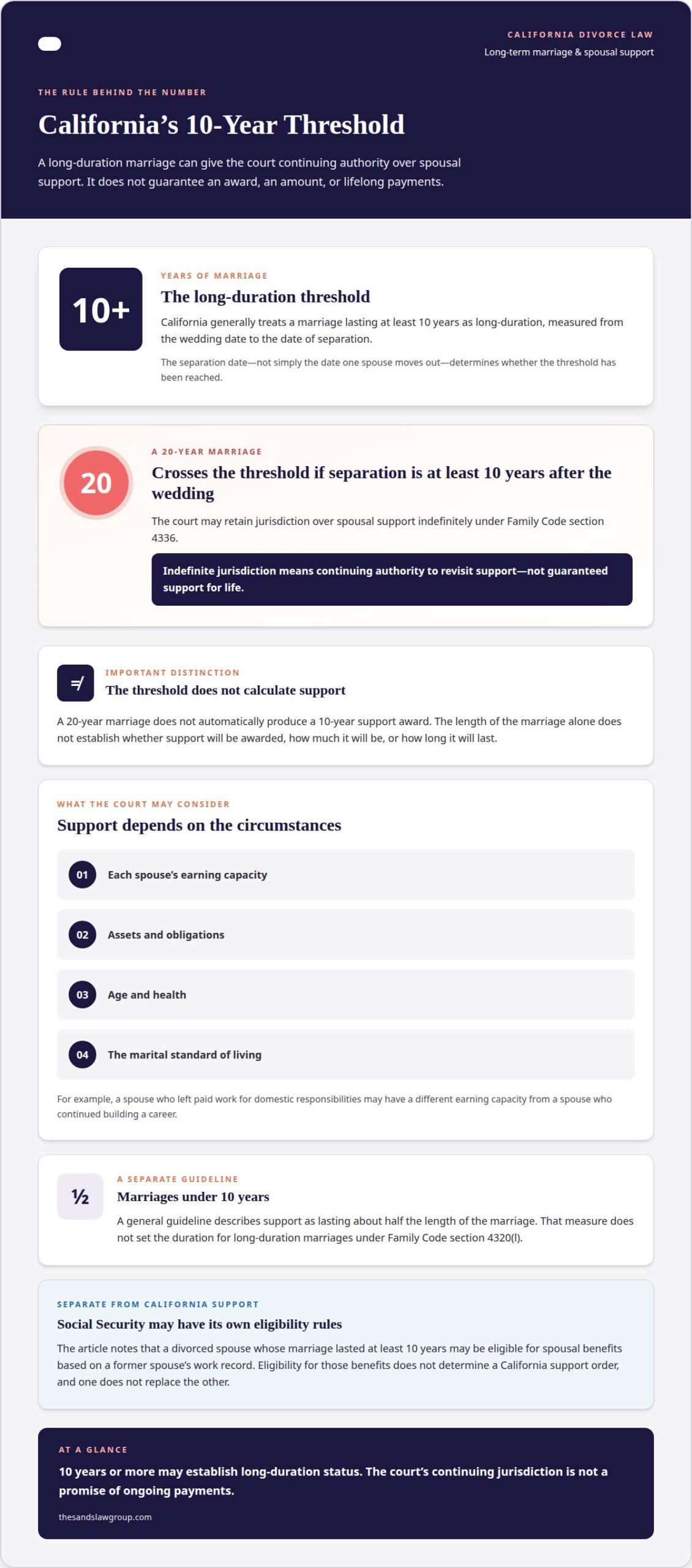
California generally treats a marriage lasting 10 years or more, measured from the wedding date to the date of separation, as a long-duration marriage. A 20-year marriage therefore crosses that threshold if the separation date falls at least 10 years after the wedding. Under Family Code section 4336, the court can retain jurisdiction over spousal support indefinitely. This gives the court continuing authority, not a promise that support will continue indefinitely.
That distinction matters when spouses plan for the years ahead. The court may retain jurisdiction while circumstances change, and support orders can be revisited when a legally relevant change occurs. The length of the relationship alone doesn’t establish an award, amount, or duration. For marriages under 10 years, a general guideline describes support as lasting about half the marriage’s length; that measure doesn’t set duration for long-duration marriages under Family Code section 4320(l).
For a 20-year marriage, there is no automatic 10-year support award. Courts consider the facts relevant to support, including each spouse’s earning capacity, assets and obligations, age and health, and the marital standard of living. A spouse who left paid work for domestic responsibilities may have a different earning capacity than a spouse who continued building a career. Those circumstances inform a realistic support order; the 10-year threshold itself does not calculate an amount.
Social Security is a separate consideration from California spousal support. According to the Social Security Administration, a divorced spouse whose marriage lasted at least 10 years may be eligible for spousal benefits based on a former spouse’s work record. Eligibility for those benefits doesn’t determine a California support order, and one doesn’t replace the other.
If children are involved, custody arrangements address parenting time and decision-making, while child support addresses financial support. Parents may reach agreements, and unresolved issues can be addressed as part of the divorce. Each issue is distinct from the court’s continuing jurisdiction over spousal support.
Mediation lets spouses work toward agreements with a neutral mediator facilitating discussion. In a collaborative divorce, each spouse has legal representation while the parties seek resolution outside a contested court process. Either approach can help address support and parenting arrangements, but the spouses still need clear written orders or agreements to establish the terms.
Because long-duration jurisdiction and support duration are different legal questions, discuss your spousal support circumstances with a family law attorney before relying on a projected timeline or amount.
Division of retirement accounts and pensions
Retirement assets earned during marriage are generally community property in California and must be divided equally. The division can involve a 401(k), an individual retirement account (IRA), or a pension, but the plan’s structure affects how the interest is identified and transferred. For a long marriage, the relevant period may include years of contributions, investment growth, and employment changes.
A defined benefit pension promises payments based on a plan formula. California’s time-rule calculation compares total years of service with the years when the spouses were married and the employee contributed to the plan. For example, if employment began before marriage, the calculation distinguishes service during the marriage from service outside that period. Plan records and the marriage and separation dates help identify the portion subject to division.
A qualified domestic relations order, or QDRO, may be required to divide a 401(k) or pension under the plan’s rules. It directs the plan administrator how to recognize a former spouse’s interest. A court’s property division order and the plan’s implementation are related but distinct steps. The order must address the particular plan and the share being assigned, so errors can complicate payment or transfer.
IRAs are handled differently. Under Internal Revenue Code section 408(d)(6), a transfer incident to divorce can divide an IRA without a QDRO while preserving its tax-deferred or Roth tax-free status. The divorce judgment or transfer instrument should identify the intended division. Taking a distribution instead of making a qualifying transfer can have different tax consequences, so the method matters.
Tax treatment also matters when spouses transfer other property. A property transfer between spouses incident to divorce is generally tax-free under Internal Revenue Code section 1041. That treatment does not eliminate future tax questions associated with the asset. For example, spouses dividing investments should consider the asset’s basis as well as its current value, because equal market values may not produce equal after-tax results.
The family home may involve both equity and mortgage liability. A court’s equal division of the community estate addresses the overall division, but a house cannot be understood by value alone. The parties may need to account for the mortgage balance and decide whether one spouse keeps the home or it is sold. A property award does not, by itself, change the mortgage contract or remove a borrower’s obligation to the lender.
Retirement and home decisions can affect long-term financial stability. A family law attorney handling property division can assess plan documents, service records, account statements, and mortgage information together. Discuss retirement and property division before final orders assign these assets.
Contemplating Divorce After a Long Marriage (20+ Years): Why Now?
After a long marriage, health coverage can be as consequential as dividing property or retirement assets. A spouse covered through the other spouse’s employer may need to plan for replacement coverage as divorce changes the household situation. This transition deserves attention before the final financial picture is settled, particularly when ongoing treatment or prescriptions make continuity important.
One possible bridge is continuation of an employer health plan through COBRA. In California, COBRA can continue an employer health plan for up to 36 months after divorce. The coverage may include a 2% administrative fee in addition to the full premium. The spouse relying on the plan should account for that premium and fee, then compare the total with other available coverage options.
Covered California marketplace plans are another option for people under age 65 who need health insurance after divorce. Divorce triggers a 60-day Special Enrollment Period to enroll in a marketplace health plan through Covered California. That window makes timing important: a person considering a change should understand when existing coverage ends and when the enrollment period applies. A gap can affect access to care and medication, so coverage dates belong in the separation plan.
Health costs also shape the practical budget after a long relationship. For example, one spouse may have relied on an employer plan while the other managed recurring medical expenses. A post-divorce budget should account for premiums, prescriptions, appointments, and ongoing care rather than assume the former household arrangement will continue. These are planning considerations, not a substitute for choosing coverage that fits a person’s needs.
California’s spousal-support factors include both spouses’ ages and health under Family Code section 4320(h). Health circumstances may also affect earning capacity and the financial resources available after divorce. An attorney can consider how documented medical needs intersect with support, income, and the marital standard of living, without treating health insurance as an automatic support award.
A practical comparison can start with three details: the current plan’s end date, COBRA’s full premium and administrative fee, and the Covered California enrollment window. For a spouse under 65, the marketplace option may be relevant; for someone considering COBRA, the potential continuation period is up to 36 months. Comparing these options helps clarify the cost and timing of coverage before making decisions about a new career, housing, or other domestic expenses.
Health insurance is one part of restructuring life after a marriage of 20 years or more. Addressing coverage alongside medical expenses, income, and support helps make the transition more realistic, especially when either spouse has ongoing care needs.
California’s 10-year long-term marriage threshold
California measures the 10-year long-term marriage threshold from the wedding date to the date of separation. A marriage lasting at least 10 years qualifies under this presumption, so a divorce after 20 years of marriage in California generally crosses that threshold. The separation date matters because it marks the end of the period used for this calculation, even if the spouses remain legally married while the divorce proceeds.
Family Code section 4336 gives the court continuing jurisdiction over spousal support in a long-duration marriage. “Indefinite” describes how long the court may retain authority, not how long support must be paid. The distinction is consequential: crossing the threshold doesn’t automatically establish alimony, guarantee a particular amount, or require lifetime payments.
Instead, the court considers circumstances relevant to support. Family Code section 4320 includes factors such as each spouse’s earning capacity, obligations and assets, age and health, and the marital standard of living. A spouse who contributed domestic labor or supported the other spouse’s career may have a different earning capacity after decades together. Those contributions may inform the court’s assessment, but they don’t replace the other statutory factors.
Marriage length also affects the general duration guideline. For marriages under 10 years, support generally lasts about half the marriage’s length. Family Code section 4320(l) makes clear that this measure doesn’t set duration for a long-duration marriage. A California divorce after 20 years of marriage therefore doesn’t automatically produce a 10-year support order. The court retains jurisdiction, then considers the parties’ circumstances and evidence when making support decisions.
In re Marriage of Morrison (1978), 20 Cal.3d 437, cautions against ending support jurisdiction after a lengthy marriage based on speculation that the supported spouse will become self-supporting. The principle underscores why a court must assess the record rather than assume future earning capacity. Evidence about work history, career interruptions, health, and financial resources can help frame that assessment.
Retained jurisdiction also allows future support orders to respond to changed circumstances. Family Code section 3651(a) permits modification or extension of support orders, while jurisdiction may be terminated by agreement or court order. The 10-year threshold concerns the court’s continuing authority, not a prediction of a specific outcome. Discuss long-term spousal support with a family law attorney who can assess the relevant facts and orders.
The Sands Law Group, APLC: Divorce Legal Representation
The Sands Law Group, APLC provides divorce legal representation for people facing the financial and personal decisions that follow a long marriage. When separation raises questions about support, retirement assets, or the family home, legal guidance can help clarify the issues and address them within the divorce proceeding.
The firm also represents clients in spousal support and property division matters, as well as child custody and visitation issues when children are involved. These issues can affect one another, so it helps to consider the full picture rather than treat each decision in isolation.
If you’re considering divorce or need help resolving disputed terms, contact The Sands Law Group, APLC to discuss your situation.
Take the Next Step With a Clear Plan
Deciding what comes next after a long marriage is personal, and the legal process can make that decision feel even more difficult. You don’t need to resolve every financial or family question before seeking guidance. A focused conversation can help identify the decisions requiring attention, the information relevant to your circumstances, and the issues that may need resolution before the divorce is finalized.
For anyone considering a divorce after 20 years of marriage in California, the useful next step is to discuss the specific facts shaping the case, rather than rely on assumptions about what a long marriage guarantees. That perspective can help you consider your priorities and approach the process with greater clarity.
Schedule a conversation with The Sands Law Group, APLC to discuss your situation and possible next steps. You can move forward thoughtfully, with a clearer understanding of the decisions ahead.
Frequently Asked Questions
So, what’s a divorce?
A divorce is the court process that legally ends a marriage and resolves related issues, such as property, support, and parenting arrangements. In California, one spouse can seek a divorce even if the other disagrees; living apart alone doesn’t end the marriage. For example, a case involving a Los Angeles home may require decisions about that property. The website content is for general informational purposes only and does not constitute legal advice.
How Does Spousal Support Differ After 10+ Years Together?
After a marriage reaches California’s long-duration threshold, the court may retain authority over spousal support without a set end date. That authority is different from a requirement to pay support indefinitely. For example, a spouse ending a 12-year marriage may face a support decision based on the parties’ circumstances, rather than a fixed duration calculated only from the marriage’s length. The court can also revisit support as circumstances change.
What Factors Do Judges Consider When Awarding Alimony?
California courts consider 14 statutory factors when determining spousal support. These include the marital standard of living, each spouse’s earning capacity, obligations and assets, and the parties’ ages and health. Courts also consider domestic contributions and documented domestic violence history. For example, a career interruption for caregiving may affect a spouse’s current earning capacity. Judges weigh relevant circumstances together rather than relying on marriage length or income alone.
What Should Spouses Expect Financially After a 10+ Year Marriage Ends?
Spouses should assess income, debts, property, support, and the cost of maintaining separate households. A practical starting point is to distinguish assets available for immediate expenses from assets intended for retirement, then account for recurring costs such as housing and health coverage. For example, a spouse receiving retirement assets may have less accessible cash for monthly bills. Tax consequences can also depend on the type and transfer of each asset.
How does California define a long-term marriage for divorce after 20 years?
California generally treats a marriage as long-duration when it lasted at least 10 years, measured from marriage to separation. For a marriage lasting 20 years, the key question is whether the legally relevant separation date falls at least 10 years after the wedding. A disagreement about that date can therefore affect whether the threshold is met. The threshold concerns the court’s support jurisdiction, not an automatic award or payment period.
How is community property divided in a California divorce after a 20-year marriage?
California courts generally divide the community estate equally after identifying community assets and liabilities and distinguishing separate property. Consider debts alongside assets rather than comparing property values in isolation. For example, a proposed division involving a home and investment accounts needs to account for the home’s mortgage liability. Records tracing an inheritance or premarital funds can also help establish whether a contribution should be treated as separate property.
How is spousal support calculated and how long can it last in California after a 20-year marriage?
California considers statutory factors to determine support and its duration; a 20-year marriage does not automatically produce a 10-year award. For temporary support, the guideline formula is 40% of the higher earner’s net income minus 50% of the lower earner’s net income. Long-duration jurisdiction allows the court to retain authority indefinitely, but that does not mean payments must continue indefinitely. Support orders may be revisited when circumstances change.
What happens to retirement accounts, pensions, and Social Security in a California divorce?
Retirement benefits earned during marriage are generally community property, and a qualified domestic relations order may be needed to divide a 401(k) or pension. IRA transfers incident to divorce follow a different process. Social Security is a separate consideration: according to the Social Security Administration, a divorced spouse whose marriage lasted at least 10 years may be eligible for benefits based on a former spouse’s work record. Eligibility rules differ from property division.

Article by
Thomas D. Sands, Esq.
Thomas D. Sands is the founder and CEO of The Sands Law Group, APLC. A California attorney with more than two decades of experience, he represents clients in divorce and family law matters as well as civil litigation and real property disputes. His approach emphasizes attentive, practical, and cost-conscious representation.
Sands is a 2023 Litigator of the Year honoree of the American Institute of Trial Lawyers and a 2023 Lawyer of the Year honoree of the American Institute of Legal Professionals. His firm has also received recognition among the 2025 Best Law Firms in America, a 2026 Benchmark Best of award, and a 2026 Law Firm of the Year honor.

Article reviewed by
Thomas D. Sands, Esq.
Thomas D. Sands is the founder and CEO of The Sands Law Group, APLC. A California attorney with more than two decades of experience, he represents clients in divorce and family law matters as well as civil litigation and real property disputes. His approach emphasizes attentive, practical, and cost-conscious representation.
Sands is a 2023 Litigator of the Year honoree of the American Institute of Trial Lawyers and a 2023 Lawyer of the Year honoree of the American Institute of Legal Professionals. His firm has also received recognition among the 2025 Best Law Firms in America, a 2026 Benchmark Best of award, and a 2026 Law Firm of the Year honor.
TOLL-FREE: 855-SANDS4U